
¿Nos afectará el conflicto con Corea del Norte?
10 September, 2017
Odisea: El Presupuesto 2018
18 September, 2017Expel Venezuela from the IMF
The free World should make a concerted effort to bring down Maduro’s oil-based autocratic regime in Venezuela. The way to make international pressure effective is to expel the country from the IMF, which would spark a massive sovereign and quasi-sovereign debt default, making the regime ultimately unsustainable.
An oil-based narco-autocracy
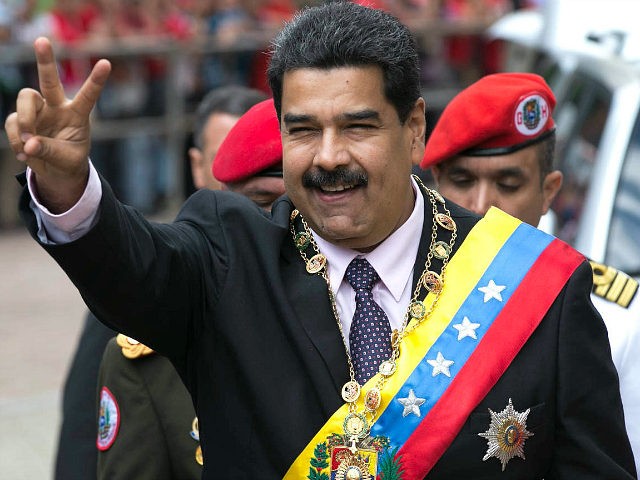
President Nicolas Maduro has been strengthening the grip on the economy and the society in recent weeks. Protests seem so far unable to deter his march toward the establishment of a narco-autocracy. The opposition will present candidates –where it is allowed—in the October regional elections, an issue that has brought divisions again. In any case, belief in the fairness of electoral processes is null after the scandal of the faked elections for the National Constitutional Assembly. A constitutionally sanctioned transfer of power seems now almost impossible.1 The government has the legal tool to maintain power, control of a Constitutional Assembly that supersedes all other pre-existing powers, and money to maintain power, the oil revenues.
Oil revenues, which make for almost all of Venezuela’s exports, are essential for Maduro to stay in power. Not only they finance the imports in an economy that has all but destroyed its productive sector. They are also vital to sustain the power scheme in which the military and government officials profit from the opacity of the exchange rate system, the trading of sovereign and quasi-sovereign bonds and the state distribution of goods.
Unilateral US sanctions are ineffective and counter-productive
Latin American governments have been very slow and ineffective to put a limit to Maduro, deterred by a few allies he still has in the region. The Organization of American States (OAS) could not condemn his government as a few Caribbean countries that are part of Petrocaribe, the alliance formed to receive oil from Venezuela under preferential conditions, vetoed the initiative. Mercosur, the Southern Cone trading bloc, only suspended Venezuela on August 7, deterred before by the left-wing government of Uruguay. Other regional bodies such as ALBA, the Bolivarian Alliance for the Peoples of our America, supported Maduro.
In this context, the US government stepped in by imposing sanctions. Initially, they applied only to Venezuelan officials. On August 25, the US government tightened sanctions and barred US-based financial institutions from dealings in new Venezuela sovereign and PdVSA bonds, including existing bonds owned by the country’s public-sector entities.
US sanctions have so far been ineffectual. Venezuela’s sovereign bond prices traded up on the day the new sanctions were imposed; some of them were up by 15%. Although the sanctions will hamper the government’s access to the markets to repay its debts and even any debt restructuring, they keep open other non-market alternatives such as financing schemes from China and Russia.
They are also counter-productive: Venezuelans at large are against US sanctions. A poll by Datanálisis in July shows that 73% of Venezuelans were against US sanctions. The government is reacting to the sanctions as if Venezuela was about to be invaded and it may help it to regain some support from the population.
US sanctions are counter-productive as they come from a big neighbor with an interventionist past and distrusted by many in the region. This suspicion among Latin Americans is not that surprising. Decades of “gun-boat” diplomacy, “dollar” diplomacy and puppet governments left a permanent strain on Latin America. US Secretary of State Richard Olney once argued that “the United States is practically sovereign on this continent”.2 President Theodore Roosevelt declared that “brutal wrongdoing, or an impotence which results in general loosening of the ties of civilized society, may finally require intervention by some civilized society, and in the Western Hemisphere the United States cannot ignore its duty”. 3 Although this Roosevelt “corollary” of the Monroe doctrine was posited many decades ago, it is still alive in the words of President Trump when he declared “We have many options for Venezuela, including a possible military option if necessary.”
Multilateralism works best
There is an alternative multilateral option that could prove much more effective in toppling Maduro’s regime: kicking Venezuela out of the IMF. There are precedents for this: in 1954, Czechoslovakia was kicked-out for “failing to provide required data”. Argentina was on route of being expelled in the last years of Cristina Kirchner’s government over issues regarding the “quality of the official data reported to the fund”.
The government of Venezuela’s policies are at odds with the IMF bylaws. The IMF’s Regional Economic Outlook of the Western Hemisphere includes an “Annex 2.1. Disclaimer”, explaining that regarding Venezuela there are information gaps, incomplete information and there are “difficulties in interpreting certain reported economic indicators in line with economic developments.” Venezuela’s consumer prices are excluded from the IMF’s flagship publication, the World Economic Outlook. In addition, Venezuela’s policies are in defiance of the IMF’s Article IV with regards to its exchange rate arrangement and the IMF’s surveillance of its policies.
It is politically feasible to expel Venezuela from the IMF. Article XXVI of the Articles of Agreement of the IMF regulate the “compulsory withdrawal” of a member. First, if a member fails to fulfill any of its obligations, the Fund can declare it ineligible to use the resources of the Fund. If, after a reasonable period, policies are not corrected, the Fund may –by a 70% majority of the voting power—suspend the voting rights of the member. If, after a reasonable period, policies are not corrected, that member may be required to withdraw from membership by an 85% of the voting power. An analysis of the voting shares 2 G. Herring, “From Colony to Superpower”, The Oxford History of the United States”, Oxford University Press, 2008, 307. 3 Ibid., 371. shows that an alliance of countries of the Americas (excluding Venezuela and its allies such as Bolivia), Europe, Asia, former members of the Commonwealth (e.g., Australia) and oil exporting countries would be almost enough to gather 85% of the votes. We are not including any African country (except South Africa), nor China nor Russia in the calculation. Active diplomacy and leadership should be able gather the desired votes.
We think that the definition of the “reasonable period” of Article XXIV and “reasonable time” of Section 22 of the IMF’s bylaws should be adapted to Venezuela’s current situation. Time is of the essence, as the economy is crumbling. Ricardo Hausmann, a Venezuelan-born professor at Harvard’s Kennedy School of Government, defined its situation as an “unprecedented collapse” that “dwarfs any in the history of the US, Western Europe, or the rest of Latin America.”
An expulsion from the IMF would set Venezuela on default. Venezuela’s external bond covenants stipulate that the end of IMF membership is “an event of default”. Debts would be accelerated. A sovereign default would most likely keep Venezuela out of other financing arrangements such as loans from China, Russia and other forms of commercial lending, as creditors do not usually want to lend to a debtor in arrears.
Although PdVSA and the Republic are two separate issuers, and there are no cross-default clauses between their bonds, we think a sovereign default may finally affect the operations of PdVSA. Although we are not lawyers, common sense indicates to us that it could be much simpler to argue that PdVSA is an “alter ego” of the sovereign than what was the case of YPF and Argentina. In fact, Crystallex, a Canadian miner, has just got an order from a US court to seize Venezuela funds held in the US. The funds were held by PDV Holding, Inc, owned by PdVSA. The brief presented by the plaintiff argues that “PdVSA is so extensively controlled by the Venezuelan Government that it is impossible to say where one ends and the other begins.”4 It would become impossible for PdVSA to keep exporting if its assets are attached around the globe.
Deprived of its cash cow, the regime would crumble, and it would be forced to negotiate a transition. We think the free World must act in a multilateral fashion, to show the regime it is not only the US that it is facing. It also must act fast, as Venezuela is experiencing a humanitarian crisis that will only deepen if the regime stays in power.