
Argentina’s Economists Warn of Deeper Slump as Crisis Escalates
4 September, 2019
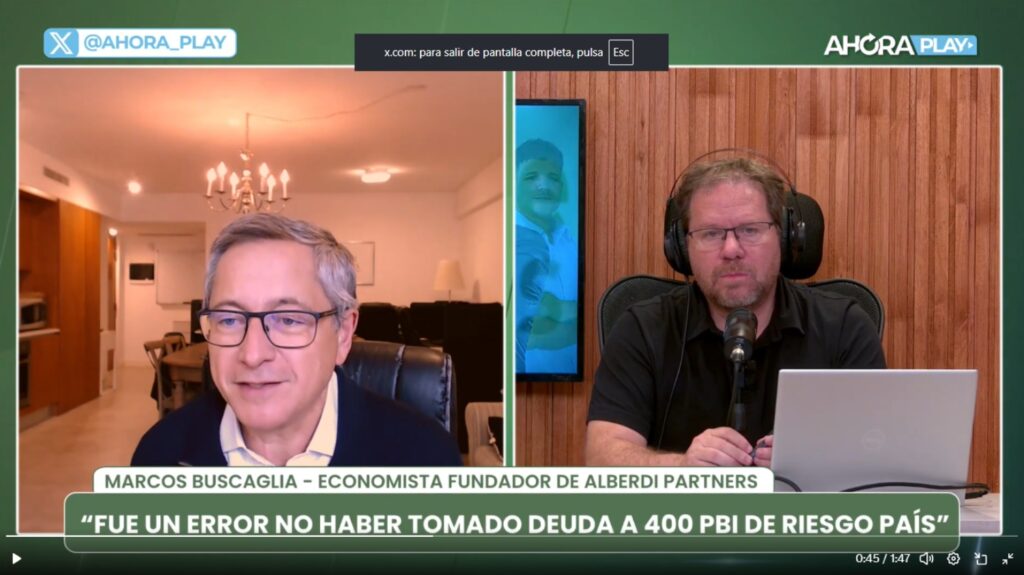
Buscaglia: “el cepo fue un error y tambien lo seria una dolarizacion”
13 September, 2019Ft.com: Argentina’s black market money changers expect resurgence in business
“Cambio, cambio!” shouts Alberto amid the hubbub of Calle Florida, a crowded pedestrian street in the downtown commercial district of Buenos Aires, alerting passers-by that he can change their money for dollars or pesos.
The “arbolito” — or little tree, as Alberto’s informal profession is known, so called for the leafy green of the dollar bills — makes eye contact with a man, lowers his voice and repeats: “Cambio, señor?” The man indicates his interest, and Alberto leads him down a gloomy side passage to an unmarked office where a money changer awaits behind a counter.
The city’s informal money changers are preparing for a resurgence in their business after the Argentine government implemented currency controls last weekend in a bid to stifle demand for foreign currency. Officials feared that a rush for dollars could strip the central bank of its dangerously low reserves and deepen a debt crisis.
“We’ve seen this all before,” says another money changer in a cramped room that features only a desk, a calculator and a money counting machine. “It’s still nothing like the boom [of black market currency trading] under the last government, but logic suggests that this relative calm won’t last much longer.”
He argues that the narrow gap of about 5 per cent between the official and black market exchange rates could easily reach around 30 per cent before long if demand for dollars increases.
President Mauricio Macri triumphantly removed strict currency controls just days after taking power in December 2015. It was a bold move that unwound a highly distorted currency market with multiple exchange rates and a gap of as much as 50 per cent between the official and black market rates.
The move was widely applauded, not least by foreign businesses that were unable to repatriate profits. It augured well for the market-friendly government after years of heavy-handed state intervention in the economy under a populist Peronist administration that drove off investment.
So the reimposition of controls represents an admission of defeat by Mr Macri, who took power promising market-friendly reforms but has failed to open up Argentina’s economy. His presidential term will be bookended with the removal and subsequent reimplementation of currency controls. The centre-right leader will finish his term with the country on the verge of a debt default after the government announced last week it needed to “reprofile” $101bn of dollar-denominated bonds borrowed in the past three years.
“These currency controls are a bad sign for foreign investment,” says one foreign executive, who fears that the controls could get harsher, especially if Mr Macri’s Peronist rival Alberto Fernández wins the presidential elections in October as widely expected.
“They may be relatively light for now, but this is just the beginning. We don’t know how this will end. But we do know that once you start with currency controls it can be hard to stop — especially in Argentina.”
Mr Macri was in apologetic mood when addressing a group of business leaders at a conference in Buenos Aires this week. The currency controls, he explained, were “to avoid greater evils” and “to protect the savings of the middle class”.
“They are measures that we do not like and are only justified in an emergency,” he added gravely.
Marcos Buscaglia, an economist in Buenos Aires, says Mr Macri is “in danger of not making it to the end of his term” in December given that central bank reserves are falling at an alarming rate, potentially triggering an acute economic crisis that could force him from power prematurely.
That has already happened twice since democracy returned to Argentina in 1983 — once during a hyperinflation crisis in 1989 and during a debt crisis in 2001 — both times with non-Peronists in power.
The currency controls have so far managed to keep the peso stable. But Mr Buscaglia argues that pressure on the black market exchange rate is likely to increase with forthcoming bond payments due to release more pesos into circulation.
Many of these are likely to be converted into dollars, which crisis-hardened Argentines know all too well is a far better currency for their savings.
“Argentina’s underlying problem is how do we get — and sustain — a currency that is not only used for transactions but also as a store of value. No one saves in pesos. That is the core of Argentina’s economic vulnerability,” says Alberto Arizu, a winemaker and the president of Wines of Argentina, a business chamber.
The money changer is sceptical that these capital controls will be shortlived. That represents an uncomfortable moral dilemma. “It might be good for business for me, but I don’t want to see my country crash on the rocks,” he says. “I love my country.”
LINK NOTA: https://www.ft.com/content/56e253f8-d00a-11e9-99a4-b5ded7a7fe3f